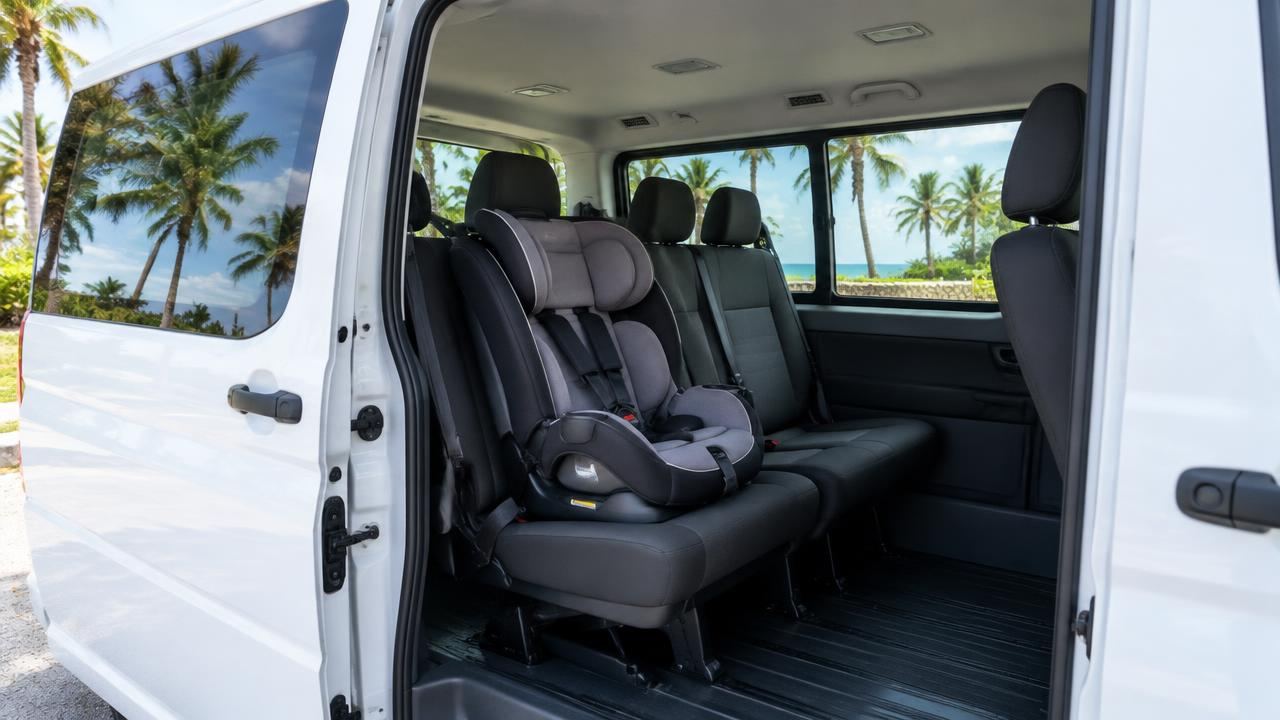
Dominican law requires a child seat for children up to 6 and a booster from 6 to 12, with all children under 12 in the back (Ley 63-17, Article 69). In practice, airport taxis and Uber rarely have seats, while private transfer companies usually supply them on request, free or for around US$5 to US$15 per seat in 2026. If your child is under 4, bringing your own seat is the safest choice.
The short answer: Book a private transfer, tell the company your child’s age and weight, and get the seat confirmed in writing. Or bring your own seat (most airlines check it free) and use any car. Do not count on finding a seat in an airport taxi or an Uber.
What the law says
The Dominican Republic’s road law, Ley 63-17 de Movilidad, Transporte Terrestre, Tránsito y Seguridad Vial, dedicates Article 69 to transporting children. In summary:
| Rule | What Article 69 says |
|---|---|
| Rear seat | Children up to 12 travel in the back, except in single-cab pickups |
| Up to 6 years | In a special child seat |
| Over 6 and up to 12 | On a booster so the rear seat belt fits safely |
| Specifications | Set by INTRANT regulation by age, weight and size |
| Penalty | Fine of one to three public-sector minimum salaries, plus licence points |
| Departure | The vehicle may not set off until children are seated as the law requires |
Two notes. First, the law refers to the child seat facing forward, while international safety guidance (WHO, and the standards used in the US, Canada and Europe) recommends rear-facing seats for babies and young toddlers. Follow your own country’s guidance for your child. Second, enforcement is uneven. You will see children on laps in cars and on motorbikes, and many taxis and guaguas (minibuses) carry no seats at all. The law is clear; the market has not caught up.
What each type of transport actually provides
| Transport | Child seats? | What to do |
|---|---|---|
| Private transfer, pre-booked | Usually on request, free or around US$5 to US$15 | Book ahead with age and weight; get it in writing |
| Shared shuttle | Sometimes, not guaranteed | Ask; bring your own for babies |
| Airport taxi | Rarely | Bring your own seat |
| Uber / inDrive | No guarantee, no in-app option | Bring your own seat |
| Hotel shuttle | Varies by resort | Ask the resort before arrival |
| Rental car | Available as an extra, often per day | Reserve in advance; check the seat yourself |
| Intercity buses (Caribe Tours, Metro Tours, Expreso Bávaro) | No | Children ride on seat belts or laps; check the operator’s rules |
Private transfers
This is the most reliable way to get a seat without carrying one. Most private transfer companies in Punta Cana, Santo Domingo and Puerto Plata list infant seats, child seats and boosters as options at booking. Some include them at no cost, some charge a small fee per seat. What to ask:
- Which type. Infant (rear-facing), convertible child seat or booster. Give your child’s age and weight, not just “a car seat”.
- How many. Two children need two seats, and a sedan may not fit two seats and three adults. A minivan often makes more sense.
- Who installs it. Drivers normally fit the seat before arrival, but check it yourself: it should not move more than a couple of centimeters at the belt path.
- Written confirmation. Ask for the seat on your booking confirmation. If it is missing at pickup, you have something to show.
Prices for the transfer itself are on each route page, for example PUJ to Bávaro and PUJ to Cap Cana. You can also mention seats when you request a quote.
Airport taxis and Uber
Airport taxis at Punta Cana Airport and elsewhere work on a first-come basis, and we found no airport taxi operation that guarantees child seats. Uber’s own airport guidance says car seats are not guaranteed and suggests bringing your own. If you have your seat, both are workable.
Rental cars
Rental companies offer child seats and boosters as extras, usually charged per day and subject to availability. Quality varies. If you rent, inspect the seat for damage, the manufacturing date and a complete harness. For a week or more, bringing your own often costs less.
Which seat to ask for, by age
When you book, describe the seat you need rather than just asking for “a car seat”. As a rough guide based on international practice (always check the seat’s own height and weight limits):
| Child | Seat to request | Notes |
|---|---|---|
| Baby, birth to about 12 months | Rear-facing infant seat | Many operators have few of these; bringing your own is safest |
| Toddler, about 1 to 4 years | Convertible seat, rear-facing as long as it fits, then forward-facing with harness | Give the weight in kilos and pounds |
| Child, about 4 to 6 years | Forward-facing seat with harness or high-back booster | Dominican law still requires a child seat up to 6 |
| Child, about 6 to 12 years | Booster (high-back or backless) | Required by Article 69 until 12 |
If your children span two stages, ask for two different seats and confirm that both fit in the vehicle with your luggage. For three children, book a van rather than a sedan.
Bringing your own seat
For babies and toddlers this is the option we recommend:
- Airlines. Most major airlines flying to the DR check a car seat free of charge, and many allow an approved seat on board if your child has a paid seat. Confirm with your airline.
- Weight and size. A lightweight travel seat or a compact folding booster makes the arrival walk at PUJ much easier.
- Installation. Many Dominican transfer vans have lap-and-shoulder belts in the rear rows; LATCH or ISOFIX anchors are not guaranteed. Practise a belt installation at home.
- On arrival. Tell your driver you have your own seat so they leave room in the trunk and the back row.
Practical tips for transfers with children
- Choose private over shared for children under about 6. You avoid the airport wait and multiple hotel stops, and you leave when your family is ready. Our private vs shared transfer guide has the price comparison.
- Long drives. PUJ to Bayahíbe takes about 1 h 15 to 1 h 45, PUJ to Santo Domingo 2 h 30 to 3 h, and SDQ to Las Terrenas around 2 h 30. Ask the driver for a stop; a fuel station break is normal. See PUJ to Bayahíbe.
- Winding roads. The roads into Las Terrenas and around the north coast have curves. Bring motion-sickness remedies for children who need them.
- Water and snacks. Many drivers offer bottled water, but do not count on it. Carry your own for the first hour.
- Late flights. A tired child at midnight is a strong argument for a confirmed private car. See our late-night and delayed arrivals guide.
- Sun and heat. A car parked in the sun heats up quickly. Ask the driver to run the air conditioning before loading children.
What we could not verify
We read Article 69 in the published text of Ley 63-17, but we could not find the INTRANT regulation that sets seat specifications, nor current enforcement data. Car seat fees vary by company; the US$5 to US$15 range comes from 2025 and 2026 booking listings, and some companies include seats free. Always confirm with your provider.
Frequently asked questions
Are car seats required by law in the Dominican Republic?
Yes. Article 69 of Ley 63-17 says children up to age 12 must ride in the back seat, children up to 6 must use a child seat, and children over 6 and up to 12 must use a booster so the rear seat belt fits. Fines are set at one to three public-sector minimum salaries. In practice enforcement is uneven, and many taxis do not carry seats.
Do airport taxis in the DR have car seats?
Usually not. Airport taxis at PUJ, SDQ and POP generally do not carry child seats, and you cannot count on one being available on the spot. If you need a seat on arrival, pre-book a private transfer that confirms it in writing, or bring your own.
Do private transfer companies provide car seats?
Many do on request, as an infant seat, a child seat or a booster. Some include it free, others charge around US$5 to US$15 per seat. Book it in advance with your child's age and weight, and ask for written confirmation.
Can I request a car seat on Uber in the Dominican Republic?
No. Uber does not guarantee car seats at Dominican airports or in the cities, and there is no car seat option in the app there. Bring your own if you plan to use Uber with small children.
Should I bring my own car seat?
For babies and toddlers, it is the safest option: you know the seat, it fits your child, and most airlines check car seats free of charge. For children old enough for a booster, a compact travel booster is easy to carry.
Are shared shuttles suitable with small children?
They are possible but less convenient: seats are not always available, you may wait 20 to 45 minutes and stop at several hotels. With babies or toddlers, a private transfer with a confirmed seat is worth the difference.