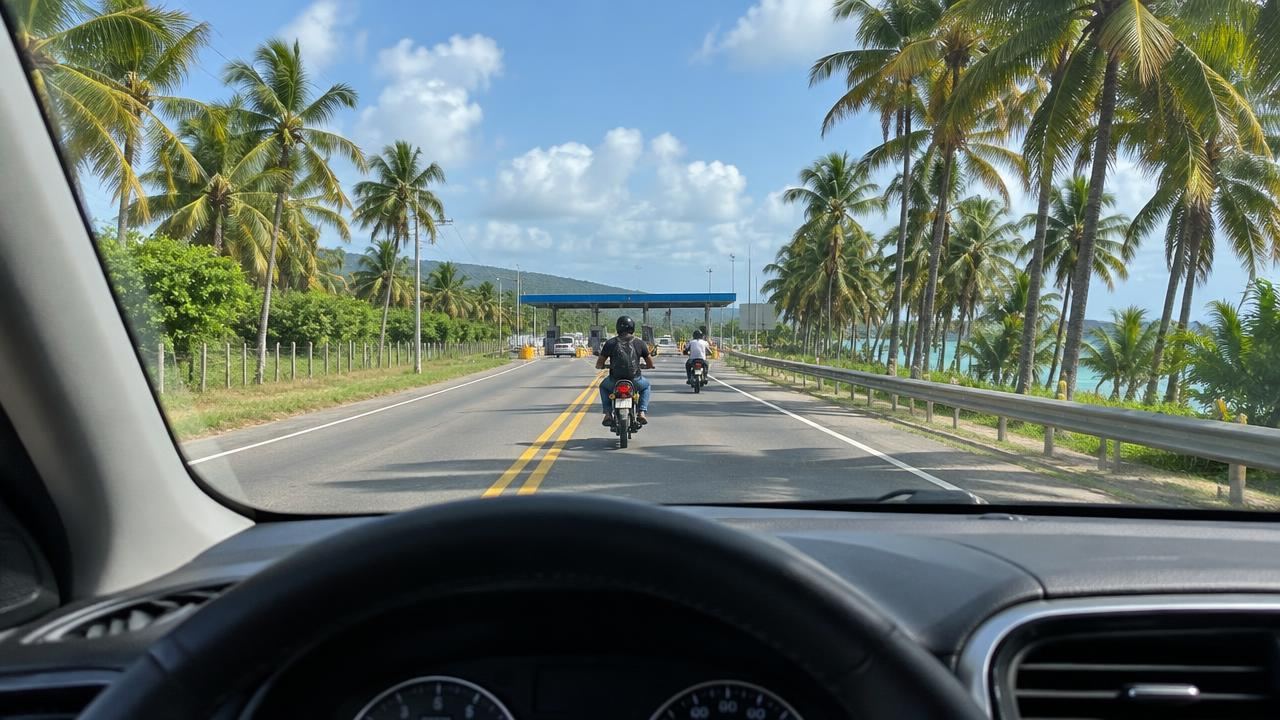
Driving in the Dominican Republic is perfectly doable if you arrive with realistic expectations: the highways between the big cities are good, tolls are cheap and Waze or Google Maps work well. The hard part is the driving style: motorbikes everywhere, lane changes without signals, unmarked speed bumps and very few lit roads outside the cities.
The short answer: with your valid licence and a credit card you can rent (generally from age 25). Most tolls are RD$100 per booth, cash only. Buy full insurance at the counter, drive defensively, don’t drive between cities at night, and skip the car if you’re only going airport to hotel: a private transfer costs less.
Before you rent
Licence. Rental companies normally accept your valid home licence together with your passport. If your licence isn’t in the Latin alphabet or you’re staying a long time, carry an International Driving Permit; it’s cheap and saves arguments at a checkpoint. We found no single official figure for how many days a tourist can drive on a foreign licence, so on a long stay, confirm with the rental company.
Age and card. Go Dominican Republic, the Ministry of Tourism’s portal, says you need to be 25 or older to rent. Some agencies accept younger drivers for a surcharge. Expect a deposit hold on your credit card, sometimes several hundred dollars.
Insurance. Buy full cover at the counter. Many credit cards’ rental cover excludes the Dominican Republic or doesn’t apply to local third-party liability, and damage claims for scratches at return are common. The same official portal recommends full cover with the Casa del Conductor option, the service that assists drivers after an accident.
Pickup check. Film the car inside and out, with the date, before you leave the lot. Check the spare tyre and the jack. Cars usually go out with a full tank and must come back full.
Do you really need one? If you’re going from Punta Cana airport to an all-inclusive in Bávaro, the car will sit in the car park all week. Compare in our transfer vs rental car guide.
The basic rules
- Drive on the right, as in the US and most of Latin America.
- Seat belts are compulsory for driver and passengers, and handheld phone use while driving is banned. The current traffic law (Law 63-17) covers both.
- Alcohol: there are legal limits and checkpoints, especially on weekends and holidays. The practical rule is simple: if you drink, don’t drive.
- Speed limits are signposted and some highways have speed cameras. In practice many people ignore them; don’t take your cue from the traffic.
- Traffic police are DIGESETT. You’ll see officers at junctions and roadside checkpoints. If you’re stopped, have your licence, passport and the car papers (in the glovebox) ready.
- Emergencies: 911 works nationwide for police, ambulance and fire.
How people actually drive
Motorbikes everywhere. Motoconchos (motorbike taxis) and private bikes overtake on the right, on the left and on the shoulder. Check your mirrors twice before any turn.
Roundabouts and junctions. Roundabouts have no marked lanes and right of way is negotiated. Go in slowly and decisively, without sudden braking.
Speed bumps. “Policías acostados” (sleeping policemen) appear on the way into almost every town, often unpainted and unsigned. On the north coast road and in the east they are constant.
U-turns on highways. Highways such as the Duarte have U-turn points off the left lane, and cars brake hard for them. Keep your distance.
Guaguas and trucks. Guaguas (minibuses) stop wherever there’s a passenger, not at fixed stops. Trucks crawl up mountain roads such as Santiago to Puerto Plata.
Horn. It means “I’m here”, not just annoyance. A short tap when overtaking is normal.
Don’t drive at night outside the cities
This is the most important advice in this guide. At night, away from the main highways, lighting is minimal, motorbikes run without lights, animals wander onto the road (cows, dogs, horses) and potholes are invisible. The official tourism portal says it plainly: avoid driving at night, even on highways. Plan transfers between regions to arrive in daylight, and if your flight lands late, book a transfer for that first night and collect the car the next day.
Tolls by route
In January 2025 the Public Works Ministry (MOPC) and the RD Vial trust raised the Las Américas, Duarte, Sánchez, 6 de Noviembre and Coral 1 booths from RD$60 to RD$100 for light vehicles. The north-east highway tolls (towards Samaná) are higher. Pay in cash, in pesos, with small notes; if you pay in dollars, change comes back in pesos. Some rental cars carry a Paso Rápido electronic tag that pays automatically; ask at the counter how you’ll be billed.
| Route | Booths | Approx. toll each way (light car, 2026) |
|---|---|---|
| Santo Domingo to Punta Cana | 4 | RD$400 to RD$500 (about US$7) |
| Punta Cana to La Romana | 2 | Around RD$200 |
| Santo Domingo to Santiago | 1 | RD$100 |
| Santo Domingo to Las Terrenas | 4 | RD$900 to RD$1,000 (about US$15) |
| Santiago to Puerto Plata | 0 on the main route | There may be one if you use the Santiago ring road |
The per-booth rates on the north-east highway (Guaraguao, Naranjal, El Catey) come from tables published in 2022 and 2026 references, and may have changed. Always carry a bit more than you expect to need.
Drive times between cities
| Route | Distance | Drive time |
|---|---|---|
| Santo Domingo to Punta Cana | 195 km | 2.5 to 3 h |
| Santo Domingo to Santiago | 155 km | 2 to 2.5 h |
| Santo Domingo to Puerto Plata | 215 km | 3 to 3.5 h |
| Santo Domingo to Las Terrenas | 140 km | 2 to 2.5 h |
| Punta Cana to Samaná | 300 km | 4.5 to 5.5 h |
| Puerto Plata to Las Terrenas | 190 km | 3 to 3.5 h |
Add 30 to 60 minutes on Friday afternoons leaving Santo Domingo, on Sunday afternoons heading back into the capital, and during Easter week, the busiest week of the year on the roads.
Fuel, parking and navigation
Fuel. Stations are full service: an attendant (bombero) fills up for you; say how much and which grade. Big stations take cash or cards. There are few stations between Monte Plata and El Catey, along the Miches coast and in the south-west; fill up before you set off.
Parking. In the Colonial Zone and in central Santiago and Puerto Plata, use attended car parks. At beaches and sights, someone offering to “watch your car” for a few pesos is normal. Leave nothing visible inside, even when there’s a guard.
Navigation. Waze and Google Maps work well on main roads. Download offline maps for Samaná, Miches, the south-west and Montecristi. A local SIM or a travel data plan saves a lot of trouble.
If you have an accident or get stopped
- Accident: if nobody is hurt, photograph the vehicles, plates and scene. Call 911 if anyone is injured and call the rental company immediately. Don’t agree to cash settlements on the spot if you’re unsure who was at fault.
- Police checkpoint: stop, greet the officer and hand over your documents. If you’re told you committed an offence, ask for the fine in writing.
- Flat tyre: on the highway, find a safe spot before stopping. Gomerías (tyre repair shops) are in almost every town and charge little.
Car, transfer or bus?
- Airport to resort and back: a private transfer or the official taxi. See prices from Punta Cana airport to Bávaro.
- City to city with light luggage: Caribe Tours, Metro and Expreso Bávaro coaches are comfortable and cost RD$275 to RD$650. See the intercity buses guide.
- Exploring a region at your own pace: rent a car, especially in Samaná, the north coast, the south-west and Montecristi.
- A day out with several stops: a private driver for the day often works out cheaper than renting if there are four or more of you.
If you’d rather not drive any of it, request a quote with your route and dates and compare before you decide.
Frequently asked questions
Can I drive in the Dominican Republic with my home licence?
For short tourist stays, rental companies normally accept a valid licence from your home country together with your passport and a credit card. Go Dominican Republic says you need to be 25 or older to rent. If your licence isn't in the Latin alphabet, or you're staying for months, also carry an International Driving Permit and check the rules with the rental company.
How much are the tolls?
Since January 2025 most booths charge RD$100 per light car. Santo Domingo to Punta Cana has four booths, around RD$400 to RD$500 each way; Las Terrenas costs about RD$900 to RD$1,000 because the north-east highway tolls are higher; Santiago is one RD$100 booth. Pay in cash.
Is it safe to drive at night?
On the main highways it's possible, but we don't recommend it outside the cities. Secondary roads are poorly lit, with motorbikes without lights, loose animals and potholes. The Ministry of Tourism itself advises planning road trips for daylight.
What do I do if I have an accident?
Call 911 if anyone is hurt, call the rental company straight away and don't sign anything you don't understand. If you bought the rental company's full cover, follow its procedure; many work with Casa del Conductor, a service that helps handle the incident. Photograph the vehicles and the scene.
Should I rent a car or book a transfer?
If you're only going from the airport to the resort and back, a transfer is cheaper and stress free. A car pays off for exploring regions such as Samaná, the north coast, Barahona or Montecristi, or if you're staying in a rental far from everything.