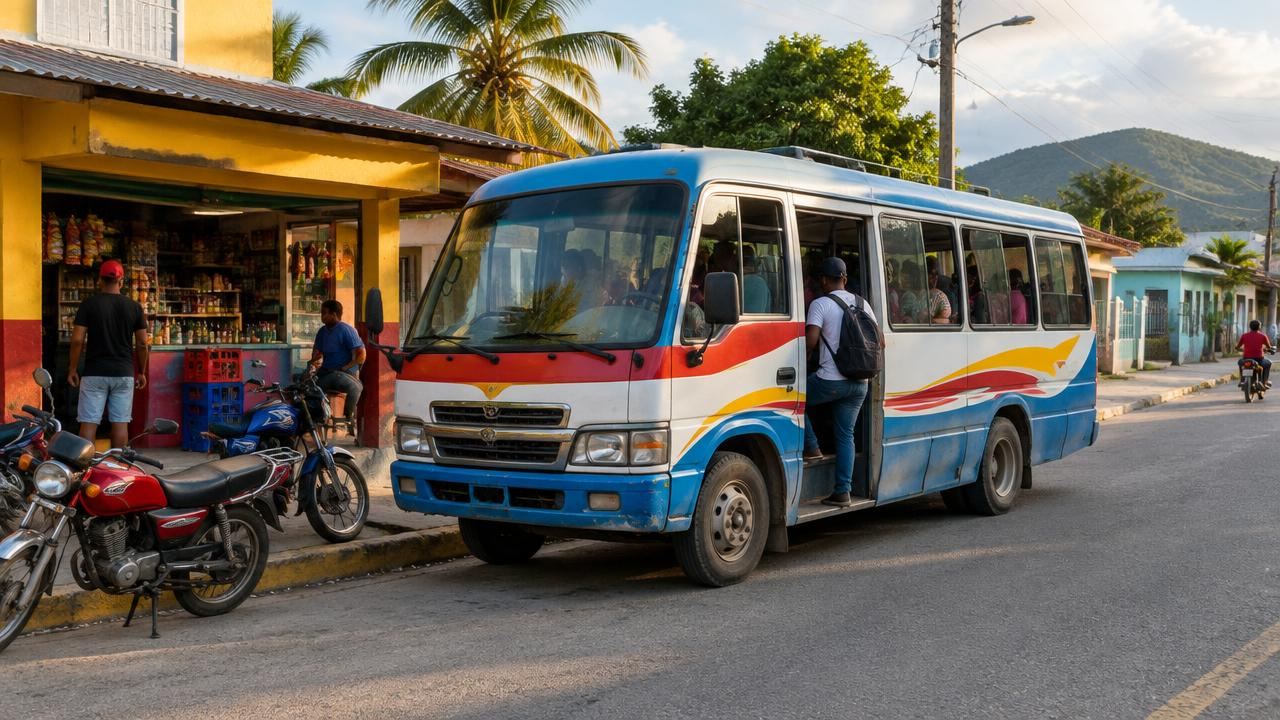
A guagua (local minibus) or a carro público (fixed-route shared taxi) costs around RD$35 to RD$50 per city ride in 2026, under a dollar, and a motoconcho (motorbike taxi) around RD$50 to RD$150 for a short hop in town. They are everyday transport for millions of Dominicans and run everywhere, but they are not designed for travelers with luggage, and motoconchos carry a high accident risk.
The short version: Guaguas and carros públicos are cheap and handy for short trips if you travel light and have some Spanish. The Santo Domingo Metro (RD$20) is the most comfortable option in the capital. Motoconchos are fast but dangerous: if you use one, keep it short, daytime, no luggage, helmet on and price agreed first. For airport to hotel, none of these is a good idea.
What Each One Is
Guagua. In the Dominican Republic “guagua” means any bus or minibus. Here we mean route guaguas: minibuses or vans running a fixed route and stopping wherever someone waves. There is a driver and a fare collector who calls out the destination from the door.
Carro público (concho). A car, usually an older sedan, running a fixed route within a city and carrying several passengers at once, often four in the back and two in front. You spot them by the route number painted on the side or a sign in the windshield.
Motoconcho. A motorbike that works as a taxi. They wait on corners, outside colmados (corner stores) and at bus terminals. They carry one passenger or, though they should not, several.
Santo Domingo Metro and cable car. Two metro lines and a cable car, with a RD$20 fare in 2026. Cleaner, safer and more predictable than any guagua.
Approximate Fares (2026)
| Mode | Approx. fare | Notes |
|---|---|---|
| Santo Domingo Metro | RD$20 | Rechargeable card at stations |
| City carro público | RD$35 to RD$50 | Varies by city and route |
| City guagua | RD$35 to RD$50 | Several Santiago routes went from RD$35 to RD$40 in July 2026 |
| Town-to-town guagua | RD$50 to RD$200 | By distance |
| Motoconcho, short ride | RD$50 to RD$150 | No official fare; negotiate first |
At roughly RD$63 to US$1, a RD$40 fare is about US$0.65. Public transport fares were contested in 2026: in July, drivers’ unions in Santiago and Puerto Plata applied increases that INTRANT (the transit regulator) said it had not authorized. In practice you pay what the route charges that day. Carry small bills and coins.
How to Ride a Route Guagua
- Ask at your hotel or a colmado which guagua goes your way and where to catch it. Signs are rare.
- Wave it down as it approaches. If it is going your way, it stops.
- Pay the fare collector during the ride or when you get off. Ask the price as you board.
- Ask for your stop by saying “me deja aquí” (drop me here) or “en la esquina” (at the corner).
- Expect a squeeze. Guaguas fill beyond what seems possible.
Useful Routes for Travelers
Punta Cana and Bávaro. Guaguas run along Avenida Barceló linking Bávaro, Cruce de Friusa, Verón and Higüey. They are handy from a Bávaro apartment to supermarkets or the public beach. From Punta Cana airport, some sources describe taking a guagua toward Verón and changing there for Bávaro; the combined fare is low, but with suitcases it is not worth it. For arrival, see the Punta Cana airport guide and the Punta Cana airport to Bávaro route.
Santo Domingo. The Metro covers much of the north-south and east-west axes; carros públicos and guaguas fill in the rest. For a visitor, Metro plus Uber is the simplest mix. More in Santo Domingo.
North coast. Guaguas run along the main road between Puerto Plata, Sosúa and Cabarete all day, widely used by residents and backpackers. See Cabarete and Sosúa.
Samaná. Guaguas link Las Terrenas, Sánchez, Samaná town and Las Galeras. Inside Las Terrenas and Las Galeras, the motoconcho is the usual way around. See Las Terrenas.
The Motoconcho: What to Know
Motoconchos are fast, everywhere and cheap. They are also the country’s most accident-prone form of transport. In June 2025 the US Embassy strongly discouraged their use because of the high accident risk: many drivers do not wear helmets and ignore traffic rules.
The mobility law (Law 63-17) requires motoconcho drivers to have a helmet, license and insurance, and a November 2025 regulation requires a certified helmet for the passenger too. On the street, compliance is patchy.
If you decide to ride:
- Short daytime trips only, on streets you know.
- Ask for a helmet. If there is none, consider another option.
- Agree the price before you get on, in pesos.
- Never with luggage, large backpacks or children.
- One passenger per bike.
- Long trousers and closed shoes help in a fall and prevent exhaust burns.
- Check your travel insurance: some policies exclude motorbike accidents.
Where Uber or taxis exist (Bávaro, Santo Domingo, Santiago, Puerto Plata), there is no reason to take the risk to save a dollar or two.
Safety on Guaguas and Carros Públicos
- Pickpockets: it happens on packed guaguas and at terminals. Keep your phone and wallet in front.
- At night: routes thin out and waiting on the roadside is not advisable. Use Uber or a taxi.
- Speed: some intercity guaguas drive very fast. If it bothers you, get off at the next town and catch another.
- Seat belts: guaguas and carros públicos rarely have them. Another reason to skip them with small children.
Carrying Money
Guaguas, carros públicos and motoconchos are cash only, in pesos. Drivers rarely have change for a RD$1,000 or RD$2,000 note, so break large bills at a supermarket or pharmacy first and keep RD$50 and RD$100 notes plus a few RD$25 coins handy. Dollars are not normally accepted on local routes, unlike in tourist taxis.
Useful Phrases
Guaguas and carros públicos run in Spanish and at speed. These phrases cover most situations:
- “¿Esta guagua va para Verón?” Does this guagua go to Verón?
- “¿Cuánto es el pasaje?” How much is the fare?
- “Me deja en la esquina, por favor.” Drop me at the corner, please.
- “¿Cuánto me cobra hasta el centro?” How much to the center? (for agreeing a price with a motoconcho or taxi driver)
- “¿Tiene casco?” Do you have a helmet?
Note that Dominicans say “carro” for car and “bola” for a free ride. If someone offers you “una bola”, it is not a paid service.
What They Do Not Cover
None of these options picks you up at a resort door with luggage, tracks your flight or carries child seats. For arriving and leaving the country, for groups and for long trips at night, an official taxi or a booked transfer is still the practical choice.
When to Use Which
- Short trip in Santo Domingo: Metro or Uber.
- Supermarket run from a Bávaro apartment: guagua or Uber.
- Getting around Cabarete or Las Terrenas without a car: walk, hotel taxi or, carefully, motoconcho.
- Airport to hotel: official taxi or booked transfer. More in Uber at Dominican airports.
- Between cities: line coaches. See intercity buses.
If you are traveling with luggage, a group or kids, you can request a transfer quote and skip the guagua changes.
Frequently asked questions
How much is a guagua in the Dominican Republic?
In 2026, city guagua and carro público routes charge around RD$35 to RD$50 per ride in places like Santo Domingo and Santiago (under US$1). Town-to-town routes cost more by distance, usually RD$50 to RD$200. Fares move with fuel prices and do not always match what the transit authority has approved.
How much is a motoconcho?
There is no published official fare. A short ride within a town is usually around RD$50 to RD$150, and tourists are often asked for more. Agree the price before you get on.
Are motoconchos safe?
They are the riskiest way to get around the country. In June 2025 the US Embassy strongly discouraged using them because of the high accident risk, noting many drivers do not wear helmets or follow traffic rules. If a car option exists, take it.
Can I take a guagua from Punta Cana airport to my hotel?
It is possible: guaguas pass on the road near the airport toward Verón and Higüey, and in Verón you change to one heading to Bávaro. With suitcases it is awkward and slow. For arrival, a taxi or booked transfer is far more practical.